Renting a Home in Eindhoven
A city that has reinvented how to live for every generation.
The history of living in Eindhoven doesn't begin with apartments or lofts, but with houses. With gardens, small squares, and the conviction that workers were entitled to light and greenery. In 1910, Philips founded the housing association 'Thuis Best' and began building Philipsdorp — one of the first garden villages in the Netherlands, complete with allotments, a central sports field, and a bandstand. This was followed by Drents Dorp for workers from Drenthe, then the Witte Dorp designed by Dudok, then the post-war grid neighborhoods in Woensel, then the cauliflower neighborhoods in the 1970s, then Meerhoven on the site of the old airport. Each generation built according to a different housing ideal, and all those layers still lie next to and intertwined with each other.
This makes the rental housing market in Eindhoven unusually varied. Those looking for a single-family home with a garden will find it in almost every district — but the character, architecture, and urban design differ by decade. The city has over 240,000 inhabitants spread across seven districts and 109 neighborhoods, and the vast majority of that fabric does not consist of the trendy lofts of Strijp-S but of ordinary residential areas with ordinary houses.
The Garden Villages: Living as a Social Act
Philipsdorp, built between 1910 and 1923, is the foundation. The street plan was designed by Gerrit Jan de Jongh — Anton Philips' father-in-law, and the man who had previously designed the Rotterdam port district Feijenoord and the Kralingse Bos. The homes were revolutionary for their time: connected to gas, water, and sewage while the rest of the surrounding villages still made do with an open sewer. The Plataanbuurt was the first residential complex in Eindhoven with an electricity connection, and the residents came from everywhere — Austrian glassblowers, Czech glass pipe drawers, Belgian oven builders. In 2003, Philipsdorp was granted protected cityscape status.
Drents Dorp followed in the 1920s. Philips struggled to recruit staff in the immediate vicinity and began looking for workers in Drenthe — ultimately, 180 families from that province were housed here. The paradox: the streets were named after places in Gelderland, not Drenthe. Part of the neighborhood was demolished in 2007 and replaced by new construction by architect Hans van der Heiden, but the original character is still recognizable in the remaining parts.
The Witte Dorp — officially Tuindorp — emerged in the late 1930s, on the other side of the city. Architect Willem Marinus Dudok, the man behind the Hilversum city hall, designed the neighborhood according to the principles of Nieuwe Zakelijkheid (New Objectivity). The almost three hundred houses were larger and more varied than in Philipsdorp. Contrary to popular belief, Philips was not involved in the construction — the location was too far from the factories.


€1,330 / month


€1,950 / month
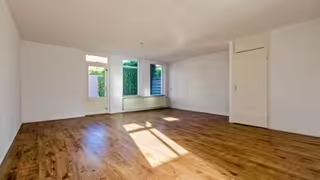


€1,715 / month


€2,325 / month


€1,950 / month


€2,295 / month
The Post-War Reconstruction Districts: Woensel as a Building Site
After the war — during which the city center was largely destroyed — urban planner J.A. Kuiper designed an expansion plan based on the image of a flower: petals around a heart. The neighborhood concept was central: each neighborhood as an independent unit with its own facilities, green spaces, and identity.
In practice, this meant an enormous expansion of Woensel. The Prinsejagt and Eckart neighborhoods adopted a 'stamped' layout: repeating patterns of terraced houses and gallery flats, efficient and rational. It was a period of housing shortage, and Philips built hundreds of system homes under license — including 238 Airey homes, recognizable by their concrete facade panels. Lievendaal, between Philipsdorp and Woensel, followed the same pattern. The neighborhoods are functional, spacious, and provided with plenty of public green spaces, but they lack the artisanal character of the garden villages.
Many of these post-war homes have since been renovated and made more sustainable, although the quality varies by neighborhood and landlord. Rental prices in the reconstruction districts are generally below the Eindhoven average, making them attractive for those seeking space without the associated price tag of the more popular city districts.
The Cauliflower Neighborhoods: A Reaction to Uniformity
In the 1970s, the mood shifted. The 'stamped' neighborhoods were perceived as dull and uniform, and architects sought a more human scale. The result was the cauliflower neighborhoods — so named because their winding street patterns resembled cauliflower florets from above.
Geestenberg, built between 1971 and 1973 on the site of a former caravan park, was Eindhoven's experiment. A varied range of housing types, lots of greenery, cul-de-sacs, play areas between the houses. Achtse Barrier followed the same principle. The cauliflower neighborhoods are popular with families due to their child-friendly design and green character, but the winding structure makes parking difficult, and the homes are sometimes smaller than you'd expect based on the floor plan.
Houses Price Breakdown in Eindhoven
| Size | Average | Median | Price Range | Available |
|---|---|---|---|---|
€2,063 | €1,950 | €1,440 - €3,750 | 21 | |
€2,970 | €2,295 | €1,750 - €5,250 | 11 | |
€1,413 | €1,413 | €1,250 - €1,575 | 2 | |
€1,746 | €1,750 | €1,228 - €2,295 | 7 | |
€1,967 | €1,995 | €479 - €3,695 | 27 |
Meerhoven and the Villa Districts: The Newest Layers
Meerhoven is Eindhoven's youngest major residential area, built on the site of the old Welschap airfield through a land swap with neighboring municipality Veldhoven. The urban design is based on the Kempen landscape: neighborhoods ranging from wooded to open grasslands, with Park Meerland — a sixty-hectare green zone — at its center. The park won the Dirk Roosenburgprijs in 2011. Meerhoven is popular with expats due to its proximity to Eindhoven Airport and the High Tech Campus, and the housing supply includes both single-family homes and apartments.
On the other side of the spectrum lie the villa districts. Karpen, around the Karpendonkse Plas in Tongelre, has the most expensive houses in Eindhoven. Koudenhoven and Den Elzent follow in price. These are neighborhoods where senior Philips executives once lived, and where the average WOZ value (property value) is well above the city average. The rental housing supply in these areas is limited, but those who find it will live in the greenest and most spacious part of the city.
The Dommel as a Green Artery
What connects all districts is the Dommel — the river that flows through Eindhoven from south to north and formed the foundation upon which the entire city was built. It was along the Dommel that the oldest settlements were located, on the sand ridges between the river and stream valleys. And it is along the Dommel that the best green connections run: from the Genneper Parken in the south (with a watermill, Iron Age settlement, and the Eindhoven Museum), via the Stadswandelpark and Philips van Lenneppark in the city center, to the Henri Dunantpark in Woensel-Noord.
The municipality is working to restore the ecological coherence along the waterway — parts of the Dommel are being re-opened, and banks are being naturalized. For housing seekers, the proximity of the Dommel zone is a concrete quality criterion: neighborhoods bordering the Dommelpark combine urban living with direct access to greenery.
Seven Districts, Seven Characters
Eindhoven was created in 1920 by the merger of five independent villages with the small city of Eindhoven. This origin is still noticeable: Strijp, Woensel, Tongelre, Stratum, and Gestel each have their own atmosphere, neighborhood structure, and type of housing. Those who broaden their search beyond the well-known names (Strijp-S, city center) will find more options, lower prices, and neighborhoods with a surprisingly unique character.
Live and Work in Brainport
The High Tech Campus in Gestel, the TU/e campus in Woensel-Zuid, the creative companies at Strijp-S and Strijp-T, and the office parks along the ring road together form the Brainport economy. Single-family homes in Gestel and Meerhoven are closest to the campus; family neighborhoods in Woensel-Noord are a fifteen-minute bike ride from TU/e. Eindhoven Airport offers direct European connections.
Brabant Scale
With 240,000 inhabitants, Eindhoven is the fifth-largest city in the Netherlands, but it feels smaller. The ring road encloses a compact urban area; most residential neighborhoods are within a ten-minute bike ride from the center. Beyond that, the Brabant countryside quickly begins: Stratumse Heide, Oirschotse bosses, Kempenland. Carnival — when Eindhoven becomes 'Lampegat' — is a yearly reminder that this is Brabant, not the Randstad.
Responding to a Rental Property in Eindhoven
The Eindhoven rental market is competitive, but the supply is larger than in many other major cities — provided you are willing to look beyond just Strijp-S and the city center. Single-family homes in Woensel-Noord, Meerhoven, and parts of Tongelre are more accessible than the city average suggests. Ensure income proof, employer statement, and ID are digitally ready. Set up an alert on our platform to receive immediate notifications of new listings in your desired neighborhood.
When viewing, ask about the construction year and renovation status — the difference in insulation and energy costs between an unrenovated post-war home and a sustainable variant is significant. A real estate agent working on behalf of the landlord may not charge you, the tenant, any agency fees.
View Current Listings
Filter by neighborhood, price, and property type.
View Rental Homes in Eindhoven