Renting a Home in Rotterdam
Two-thirds of all homes in the city are rental properties. Nowhere else in the Netherlands is the rental market as large, as diverse, and as divided across two banks.
Rotterdam is built on rental. Of the almost 298,000 homes in the city, 66 percent are rental properties. That percentage is one of the highest in the Netherlands, and it explains why the Rotterdam rental market works differently from those in Amsterdam or Utrecht. There's more supply, wider distribution across neighborhoods, more variation in price and type. At the same time, demand is enormous. The city has about 655,000 inhabitants (2025) and is growing. The Nieuwe Maas divides Rotterdam in two. To the north are the city center, Blijdorp, Kralingen, Hillegersberg, and Prins Alexander. To the south are Feijenoord, Charlois, IJsselmonde, and Hoogvliet. This separation is more than just geography. North and South have different characters, different housing stocks, and different price ranges. Those considering renting a home in Rotterdam are not just choosing a city but a riverbank.
Blijdorp and Oude Noorden: Pre-War Living Near the Center
Blijdorp is not like the Rotterdam we know. 1930s homes with bay windows and front gardens, wide avenues with plane trees, a zoo as a neighbor. The neighborhood is located directly north of the Central Station and owes its character to its building period: most streets were laid out in the 1920s and 1930s, before the 1940 bombing. Upper and lower-level apartments dominate, with an occasional terraced house with a garden. It's the neighborhood families and young professionals choose when they want urban living without having to go high-rise.
Oude Noorden, east of Blijdorp, is rawer. Pre-war buildings on narrow streets, many upper and lower-level apartments, a mix of residents that reflects the city. Zwaanshals is the shopping street that sets the character: independent shops, coffee places, a Turkish bakery next to a vintage store. Oude Noorden is a neighborhood on the move. Rents are lower than in Blijdorp, the supply is larger, and the atmosphere is less polished. For renters who prefer character over comfort, Oude Noorden is the logical starting point.


€933 / month

€7,400 / month


€2,450 / month

Price on request
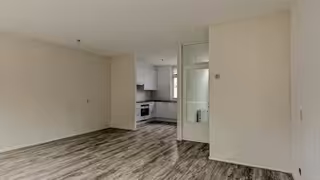


€1,605 / month


€2,250 / month
Hillegersberg: The Village in the City
Hillegersberg doesn't feel like Rotterdam. The Bergse Voorplas and Achterplas lie like two lakes in the middle of the neighborhood, surrounded by villa streets and marinas. The housing varies from detached houses from the 1920s to terraced houses from the 1950s in the 110-Morgenbuurt. The Kleiwegkwartier, closer to the center, has closed building blocks from the 1920s and 1930s. Kleiweg itself is the shopping street that gives Hillegersberg its village heart.
It is Rotterdam's most expensive residential area, and this is noticeable in the rental housing supply. What becomes available in the free sector sells quickly and at a price closer to Kralingen than the city average. Schiebroek, directly to the north, offers a more modest alternative: post-war low-rise buildings, more social housing, lower prices. The two districts share a territorial division but not a character.
Prins Alexander: The Largest Residential Area in the Netherlands
With over 96,000 inhabitants, Prins Alexander is Rotterdam's largest residential district and one of the largest in the country. The district stretches along the east side of the city, from Het Lage Land to Nesselande. The neighborhoods within the district range from 1970s constructions in Zevenkamp to the Nesselande water district, built only after 2000 on the Zevenhuizerplas.
Nesselande is the newest part of Rotterdam. Single-family homes with gardens, water as a structuring element, a small beach by the lake. It's the neighborhood that attracts families looking for new construction and space within the municipal boundaries. Oosterflank, built in the 1980s, offers a mix of low-rise and single-family homes in a more compact layout. Zevenkamp, from the same period, is more spacious with more greenery. For renters looking for square meters at a lower price than Blijdorp or Hillegersberg, Prins Alexander is the district with the broadest offering.
South of the Maas: Katendrecht, Pendrecht, and the Neighborhoods That Are Changing
Rotterdam-South is a city unto itself. More than 200,000 people live south of the Maas, spread across neighborhoods that differ more among themselves than the collective image of South suggests. Katendrecht, the former Cape Verde, has transformed in fifteen years from a forgotten port peninsula into one of the city's most popular residential areas. The Fenixloods, Deliplein, the restaurants along the quay: it's urban transformation in its most visible form. Rental properties in Katendrecht are in demand and go quickly.
Pendrecht, further south, is another story. The neighborhood was designed by urban planner Lotte Stam-Beese and built in the 1950s. Grid structure, lots of greenery, low-rise buildings. It's reconstruction architecture with a vision: light, air, and space as guiding principles. Rents are well below the Rotterdam average. Lombardijen and IJsselmonde, in the same part of South, offer similar housing types from the 1950s to 1970s. For renters looking for space for less money and willing to cross the Maas, South is the search area with the most options.
Harbors Becoming Homes: Merwe-Vierhavens and Feyenoord City
The biggest change in the Rotterdam housing market is occurring in former harbor areas. Merwe-Vierhavens (M4H), west of Delfshaven, is being transformed from a harbor basin into a living-and-working district. Approximately 2,760 homes are planned, with construction starting around 2026. The concept mixes living with manufacturing industry: a neighborhood where factories and apartments stand side by side.
On the south bank, the city is working on Feyenoord City, around the current De Kuip stadium. The area vision combines housing development along the Maas with amenities and public space. These projects will only be fully completed years from now, but they illustrate the direction: Rotterdam is building not on the periphery but in the harbor. For renters, this is relevant in the long term. New supply in former harbor areas expands the market and changes the character of entire city districts.
Houses Price Breakdown in Rotterdam
| Bedrooms | Average | Median | Price Range | Available |
|---|---|---|---|---|
€3,300 | €3,300 | €2,650 - €3,950 | 2 | |
€2,442 | €2,450 | €1,345 - €3,500 | 8 | |
€4,065 | €2,850 | €1,495 - €8,900 | 12 |
Five Metro Lines and a City on the Move
Rotterdam has something most Dutch cities don't: a real metro network. Five lines connect North and South, East and West, center and suburbs. The Erasmus Line, the Caland Line, the Hofplein Line: together they cover most of the city. On top of that are tram and bus lines and Central Station as a train hub to The Hague, Dordrecht, Utrecht, and Schiphol.
This accessibility makes neighborhood choice more flexible than in cities without a metro. Living in Prins Alexander and working in the center is twenty minutes by metro. Living in Hoogvliet and working on Kop van Zuid is half an hour. The metro compensates for distance and makes neighborhoods attractive that would otherwise be too far from the center. For renters optimizing price-quality, the metro map is at least as important as the neighborhood map.
Reconstruction City
The bombing of May 14, 1940, destroyed the center of Rotterdam. The reconstruction that followed made the city what it is today: a laboratory for architecture and urban planning. The Lijnbaan (1953), Europe's first shopping promenade. Piet Blom's Cube Houses. The Erasmus Bridge. The Markthal. Rotterdam builds not on tradition but on experiment, and this is reflected in the housing supply: from post-war grid neighborhoods to harbor lofts.
The Harbor as an Engine
Rotterdam's port is the largest in Europe. From Noordereiland to Maasvlakte, the port area stretches over forty kilometers. This port has shaped the city: the working-class neighborhoods in the South, the mansions of port barons in Kralingen, the transformation of Katendrecht, and soon M4H. The port is shrinking in the city and growing towards the sea, and every square meter that becomes available is turned into housing.
North Versus South
The Nieuwe Maas is more than a river. It is a dividing line that splits the city into two halves with different characters, different housing stocks, and different price ranges. North is on average more expensive, greener, and consists of older buildings. South is more affordable, more diverse, and changing faster. The Erasmus Bridge (1996) and the metro connect both banks, but the difference in identity remains. The neighborhood choice in Rotterdam begins with the question: North or South?
Renting a home in Rotterdam means choosing from a market larger than in any other Dutch city. The supply is spread across two banks, dozens of neighborhoods, and all price ranges. Make sure income statements and identification documents are ready, set up a search alert, and respond quickly to new listings. Look beyond Blijdorp and Kralingen. Prins Alexander offers space, the South offers value, and the metro takes you everywhere. The apartments and rooms pages for Rotterdam cover listings for smaller households and the city center.
View Rental Properties in Rotterdam
Filter by neighborhood, property type, and price.
View rental properties in Rotterdam