Rent an Apartment in Enschede
The textile city that reinvented itself — from factory districts to a campus city on the German border.
Enschede was built by textiles. From 1860, factories grew along the railway lines, workers came from Drenthe and Zeeland, and districts emerged that still shape the city today: garden villages with crooked streets and red gabled roofs, built by order of the Van Heeks and other textile families. In its heydays, more than fifty thousand people worked in Enschede's factories, and the city was, after Manchester, Europe's largest textile producer.
Apartments in Enschede
When the textile industry collapsed in the 1960s — eighty-five percent of the labor force was in that sector — the city had to reinvent itself. The establishment of the Technical University Twente in 1964, on the expropriated Drienerlo estate, marked the beginning of a second identity: city of knowledge, student city, technology region. These two layers — the factory city and the campus city — still determine where and how you live in Enschede. Those considering renting an apartment in Enschede navigate through both.
Within the Singels
The center of Enschede is bordered by a ring of canals (singels) — the Hengelosestraat, the Oldenzaalsestraat, the Gronausestraat — which separate the city center from the surrounding neighborhoods. Within these singels are seven neighborhoods: the City Center itself, Boddenkamp, De Bothoven, Hogeland-Noord, Horstlanden-Veldkamp, De Laares, and Lasonder-Het Zeggelt.
The Oude Markt is the heart: the largest city square in the Netherlands if you count the terraces, and on Thursday evenings and weekends, the focal point of student life. The H.J. van Heekplein, named after the textile baron, stands on the site where the factories once stood. The Twentec tower is a reminder of that period. The apartment supply in the city center consists of upper floors above shops, converted warehouses, and a number of new-build complexes on former factory sites. The properties are compact, rents are higher than elsewhere in the city, but you have everything within walking distance.
Boddenkamp and Hogeland-Noord, directly to the west and northeast of the city center, were traditionally the neighborhoods of the middle class and office workers — in contrast to the working-class districts further away. The homes are larger, the streets wider, the architecture stately. These are the neighborhoods where you will find apartments in pre-war buildings with high ceilings.


€706 / month


€789 / month
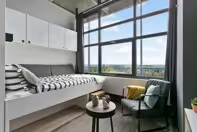


€999 / month


€999 / month


€999 / month


€1,310 / month
Roombeek: The District That Was There Twice
On May 13, 2000, 177 tons of fireworks exploded in the Roombeek district, on the north side of the city center. Twenty-three dead, more than a thousand injured, forty hectares of city destroyed. The ensuing reconstruction became an experiment in participatory building that attracted international attention. Urban planner Pi de Bruijn was given carte blanche. The municipality established a separate project office. The rules: everyone who had lived in the district was allowed to return. Streets remained where they were. Trees that had survived the explosion were not allowed to be cut down. Project developers were kept out — residents became their own clients.
The result, after more than six hundred million euros in investment, is a district where every building has its own architect. The Balengebouw, whose top was lifted to insert a glass floor. The Eekenhof with its round architectural style. Canal houses along the former railway line to Losser. Garden architect Piet Oudolf designed the planting. Rijksmuseum Twenthe and De Museumfabriek — housed in one of the few factory buildings that survived the explosion — together form the cultural center of gravity.
The apartment supply in Roombeek is special but limited. The homes are predominantly owner-occupied, and the rental properties that exist rarely change occupants. But if something becomes available, it is architecturally unique.
Pathmos and the Working-Class Districts
The textile barons not only built factories but also homes for their workers. Pathmos, southwest of the center, is the most striking example. Textile magnate Jan Herman van Heek had almost a thousand homes built between 1914 and 1928, modeled after an English garden village: winding cobbled streets, brick houses with red gabled roofs, arcades, a central square with a school and bathhouse. The Spinnerplein was its heart. The district was self-sufficient — workers did not need to leave Pathmos.
In 1927 came the last expansion: 226 houses on the north side, built for laborers recruited from the Drenthe peat colonies. Informally, this part was called the 'Drentse dorp' (Drenthe village). It was more austere than the rest — smaller houses, straight streets, less greenery. The textile dream was already fading. The Drentse dorp has since been demolished during renovations around the turn of the millennium.
Pathmos is a neighborhood in transition today. De Woonplaats is working with the municipality on a future plan. The homes are predominantly single-family, but apartments can be found on the edges of the district and in renovated complexes. The same dynamic plays out in De Laares, Lasonder, and Getfert — former working-class neighborhoods within or directly outside the singels, where gallery flats and upper-floor apartments constitute the majority of the offerings.
The Campus and the Northwest
The University of Twente is not in the city but between it — on the former Drienerlo estate, one hundred and forty hectares of forest, pastures, and water, precisely between Enschede and Hengelo. It is the only campus university in the Netherlands: student housing, faculty buildings, sports facilities, and shops on one site. Van Tijen and Van Embden designed the urban plan in the 1960s. Architect Piet Blom used the trusses of the estate's old farmhouse in his design for the cafeteria.
Twekkelerveld, the neighborhood directly adjacent to the campus, is the logical overflow area. De Woonplaats is redeveloping 150 addresses here under the name 'Nieuw Twekkelerveld' (New Twekkelerveld). Enschede Kennispark station — formerly Drienerlo — is within walking distance. Kennispark itself, the strip between campus and city, houses more than seven hundred spin-off companies. For those working in the technology sector, this is the center of gravity.
Apartments Price Breakdown in Enschede
| Bedrooms | Average | Median | Price Range | Available |
|---|---|---|---|---|
€994 | €999 | €848 - €999 | 28 | |
€922 | €864 | €507 - €1,600 | 21 | |
€1,398 | €1,360 | €953 - €2,250 | 29 | |
€1,348 | €1,225 | €1,050 - €2,650 | 10 |
The Southern Districts
South of the A35 are the large post-war expansions: Wesselerbrink, Stroinkslanden, and Helmerhoek, all three built from the 1960s onwards. These are neighborhoods with many gallery flats and maisonette apartments, their own shopping centers, schools, and sports facilities. Helmerhoek, the youngest of the three, is the most sought-after — more spacious, greener, fewer social problems. Wesselerbrink has a sustainability challenge and struggles with the reputation shared by many post-war neighborhoods in the Netherlands, but consequently also offers the lowest rents in the city.
Glanerbrug and Eschmarke
On the east side of Enschede, against the German border, lies Glanerbrug — the largest village within the municipality. It has grown together with the city and is historically linked to textiles: many residents worked across the border, in Gronau. The atmosphere is different from the rest of Enschede — less convivial, more of a border mentality. Directly south of Glanerbrug are the new-build neighborhoods of Eschmarke, Eilermarke, and Eekmaat, where significant construction has taken place in recent years. The apartment supply here is modern, energy-efficient, and relatively spacious, but the distance to the center is noticeable.
Three Corporations, One Lottery System
De Woonplaats, Domijn, and Ons Huis allocate their social housing units through a lottery system — those who respond have a chance, regardless of registration time. There are plans to partially switch to allocation based on waiting time. The municipality is also investigating priority for residents with local ties. Via woninghuren.nl, you can see which homes are offered through lottery and which are based on registration time.
Border City
Enschede has its own train connection to Gronau, and from there to Münster and Dortmund. Germany is not a foreign country — it's the backyard. Many Enschede residents refuel across the border, the Aldi and Lidl in Gronau are fuller with Dutch license plates than German ones, and on Saturdays, half of Glanerbrug flocks to the Weihnachtsmarkt. For renters, it means: an international dimension you don't find in Deventer or Zwolle.
Saxion and the Student Population
Besides UT, Enschede also has Saxion University of Applied Sciences, with branches spread throughout the city. Together, they create a student population that keeps the city young and vibrant but also puts pressure on the apartment supply. The Oude Markt is student territory on Thursday evenings. In neighborhoods like Velve-Lindenhof and De Bothoven, room rentals are the norm.
Rent an Apartment in Enschede: Where to Start
Enschede is more affordable than the Randstad and offers more square meters per euro than most cities in the west. Waiting times for social housing are unpredictable due to the lottery system — you might be lucky after three months or unlucky after three years. The free market is growing, especially in the new-build neighborhoods on the outskirts. In the center and Roombeek, supply is scarce and highly sought after. The southern districts and Twekkelerveld offer the most volume. Set up an alert on our platform so you can react immediately when something becomes available.
View Current Listings
Filter by neighborhood, price, and property type.
View Apartments in Enschede