Renting a Home in Velve-Lindenhof, Enschede
A neighborhood with three building layers: an organically grown working-class neighborhood from 1890-1920, a planned addition from the 1920s for workers of the Ramie Unie, and a post-war infill connecting both parts.
Velve-Lindenhof has approximately 4,805 inhabitants (2024) and consists of two originally separate neighborhoods that were merged during the twentieth century. The district is located south of Enschede's city center, within cycling distance of the city center and the University of Twente. Renting a home in Velve-Lindenhof provides access to one of the city's most layered neighborhoods.
Velve: Organic Growth, 1890-1920
The oldest part of the neighborhood is Velve, which developed spontaneously between 1890 and 1920 on the edge of the industrial city. Enschede experienced explosive growth during that period due to the textile industry. Between 1870 and 1900, the population nearly decupled. The demand for workers' housing was enormous. Velve emerged without an urban plan, along existing paths and roads. The street structure follows the logic of the landscape, not that of a drawing board.
This organic character is still visible. The streets do not run at right angles. Some plots have irregular shapes. The buildings vary more by street than in planned neighborhoods. For renters who seek character over uniformity, this is a quality.
Apartments Price Breakdown in Enschede
| Size | Average | Median | Price Range | Available |
|---|---|---|---|---|
€1,462 | €1,598 | €1,125 - €1,600 | 6 | |
€2,650 | €2,650 | €2,650 - €2,650 | 1 | |
€966 | €947 | €507 - €1,350 | 15 | |
€1,346 | €1,343 | €953 - €2,250 | 32 | |
€998 | €999 | €700 - €1,950 | 63 |
Lindenhof: Workers of the Ramie Unie
Lindenhof was built in the 1920s for the workers of the Ramie Unie, a textile company that processed ramie fibers. The neighborhood was systematically designed, in contrast to the organic Velve. Terraced houses on straight streets, a scale typical of workers' housing from that period. The Ramie Unie no longer exists, but the neighborhood built for it still stands.
After World War II, the area between Velve and Lindenhof was filled with terraced houses from the post-war reconstruction period. This connecting development gives the entire area its current size. Three building periods side by side, from organic to planned to functional post-war.
Housing Supply
The housing stock of Velve-Lindenhof predominantly consists of ground-level terraced houses. The Velve section has the most variation in type and year of construction. The Lindenhof section has more consistent building. The post-war infill features the most functional construction.
The rental market share is present but less dominant than in Pathmos. Some of the homes are owned by housing corporations. The free sector supply consists of privately rented terraced houses and a limited number of apartments. Starters looking for an affordable home within walking distance of the city center sometimes choose Velve-Lindenhof as an alternative to the more expensive city center.


€706 / month


€789 / month
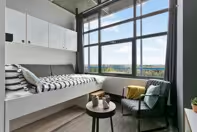


€999 / month


€999 / month


€999 / month


€1,310 / month
Accessibility and Daily Life
The city center of Enschede is a five to ten-minute bike ride away. Enschede Station is also reachable within ten minutes by bicycle. The University of Twente on the south side of the city can be reached via the city center in fifteen to twenty minutes by bike.
The neighborhood has its own amenities. Small concentrations of shops along the main roads. For larger groceries, the city center is the designated place. The range of amenities within the neighborhood itself is functional but not extensive.
Three Building Periods in One Neighborhood
Velve-Lindenhof has a streetscape that is never monotonous. The organic construction from 1890-1920, the planned workers' houses from the 1920s, and the post-war terraced houses each give a different character to the street. Those who appreciate varied urban structures will find more in Velve-Lindenhof than in any random expansion district.
Textile Industrial Heritage in the Street Structure
Lindenhof was built for the workers of the Ramie Unie. This origin is no longer visible in the neighborhood itself, but it gives the area a historical layering that later expansions lack. Enschede grew large due to textiles, and in Lindenhof, that history is embodied in stone.
Short Distance to City Center and University
Velve-Lindenhof is a five to ten-minute bike ride from the city center and a reasonable cycling distance from the University of Twente. This makes the neighborhood suitable for both students and professionals who want to live close to the city center without paying city center prices.
View Properties in Enschede
Set up a search alert and receive instant notifications for new listings in Velve-Lindenhof.
View Apartments in Enschede