Renting a Home in Purmerend
Market town in Waterland with three train stations, twenty minutes from Amsterdam, and more single-family homes than the regional average.
Purmerend has grown in fifty years from a village of ten thousand inhabitants to a city of more than ninety thousand. This growth happened in waves. In the 1960s and 1970s, Wheermolen and Overwhere emerged, built for Amsterdammers seeking space. Around 2000, Weidevenne followed, the largest expansion, with more than seven thousand homes in a district larger than many independent villages. And in 2022, the municipality merged with Beemster, the UNESCO polder north of the city.
The result is a municipality of over 90,000 inhabitants (2025) that is projected to grow to 107,000 by 2040. Purmerend has three train stations, its own city center with shops and restaurants around the Koemarkt, and a housing stock that is 71 percent single-family homes. This latter figure is notable: the average in the Amsterdam Metropolitan Area is 48 percent. Those considering renting a home in Purmerend will find what Amsterdam can no longer offer: a house with a garden, twenty minutes by train from Central Station.
The Koemarkt and the City Center: The Historic Core
Purmerend's city center is built around the Koemarkt, the square where the cheese and cattle market was held for centuries. The Cheese Market still exists, every Thursday in the summer. The square is surrounded by shops, restaurants, and the town hall. The Peperstraat, the Gedempte Where, and the Weerwal form the shopping streets that cross the center.
The architecture in the center is mixed: historic buildings along the canals, post-war reconstruction from the 1950s, and later infill. Living in the center means living above shops, in upper floors and apartments. Single-family homes are scarce here. Purmerend station is a five-minute walk away. The weekly market on Wednesdays and Saturdays gives the center a rhythm that the suburbs lack. For renters who want amenities within walking distance and are willing to live in smaller spaces, the center is the most compact search area.


€2,200 / month
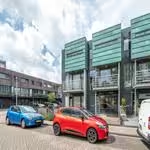


€2,250 / month
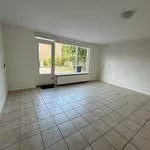


€2,100 / month


€2,500 / month


€4,500 / month
Weidevenne: The City's Largest District
Weidevenne was built around 2000 and has more than seven thousand homes. It is Purmerend's largest district, with its own train station (Purmerend Weidevenne), a shopping center, primary schools, and sports facilities. The district is divided into neighborhoods with names like Europa, Amerika, Azië, and Afrika. The housing consists predominantly of single-family homes: terraced houses and semi-detached houses with gardens, interspersed with apartment complexes.
The homes are energy-efficient for their construction year, the streets are spacious, and the greenery is present but young. Weidevenne is the district where families with children settle: playgrounds, wide sidewalks, schools within cycling distance. The rental housing supply in the private sector here consists mainly of single-family homes that become available when residents move. The district is fully built. No new homes are being added, so the supply depends on turnover.
Wheermolen: The Sixties District Renewing Itself
Wheermolen is located south of the city center and dates from the 1960s. The district was built at a rapid pace with limited budgets. Gallery flats, narrow streets, cramped floor plans. It is the district that has lasted the longest without major renovation, and that was evident. Until now.
Wheermolen-Oost is undergoing restructuring. Housing corporation Intermaris is demolishing outdated flats and building energy-efficient homes in their place. The first 71 homes on Gouwzeestraat are under construction, with a start date in 2025. This is the beginning of a transformation that will change the district in the coming years. For renters, this means two things: in the short term, varying supply due to demolition and new construction, and in the longer term, a district that will be more modern and greener than it ever was.
Overwhere and Purmer-Noord: The Northern Districts
Overwhere is the largest district after Weidevenne, with over 14,000 inhabitants. The housing is post-war, predominantly from the 1960s and 1970s. Single-family homes and low-rise flats in a green setting with wide avenues. The district has its own train station (Purmerend Overwhere), providing direct accessibility to Amsterdam and Hoorn.
Purmer-Noord, east of Overwhere, has a similar profile. The reclaimed land of De Purmer, the polder area from which the city derives its name, borders the district. This is where the open landscape of Waterland begins. The homes are more spacious than in Wheermolen, the plots larger, and the atmosphere more suburban. For renters seeking space and greenery with a station within cycling distance, Overwhere and Purmer-Noord are the areas to search.
Houses Price Breakdown in Purmerend
| Bedrooms | Average | Median | Price Range | Available |
|---|---|---|---|---|
€2,200 | €2,200 | €2,200 - €2,200 | 1 | |
€2,175 | €2,175 | €2,100 - €2,250 | 2 |
Three Stations, Twenty Minutes to Amsterdam
Purmerend has three train stations: Purmerend (city center), Purmerend Weidevenne, and Purmerend Overwhere. All three are on the intercity line Amsterdam Centraal, Purmerend, Hoorn, and Enkhuizen. Travel time to Amsterdam Centraal is twenty to 25 minutes. During peak hours, the intercity runs directly, without intermediate stops.
This connection is the reason Purmerend is growing. Amsterdammers who want more space, a garden, an extra bedroom, find what the capital can no longer offer here. The A7 runs along the city for those commuting by car, but the train is faster and more predictable for most commuters. With three stations in the city, almost everyone lives within cycling or walking distance of a platform.
The Koemarkt: Eight Centuries of Trade
Purmerend originated as a marketplace in the peatland of Waterland. The Koemarkt was the center of regional cheese and cattle trade. That function still exists: every Thursday in the summer, a cheese market is held on the square. The market tradition is more than folklore. It explains why Purmerend has a center that is larger and more complete than you would expect from a city of this size.
Beemster: UNESCO in the Backyard
Since the 2022 merger, Beemster has been part of the municipality of Purmerend. Beemster, reclaimed in 1612, is a UNESCO World Heritage site due to its geometric parcelling pattern. Fort Beemster is part of the Defence Line of Amsterdam, also a World Heritage site. Two UNESCO monuments in one municipality: no other city in the Randstad has that.
From Village to City in Fifty Years
In 1970, Purmerend had ten thousand inhabitants. Now there are more than ninety thousand. This growth occurred in waves of expansion districts: Wheermolen in the 1960s, Overwhere in the 1970s, Weidevenne around 2000. Each wave brought a new generation of Amsterdammers seeking space. The pattern repeats: the city is growing to 107,000 inhabitants by 2040.
Renting a home in Purmerend is faster than in Amsterdam but requires the same preparation. Make sure income proof and identification documents are ready, set up a search alert for new listings, and look beyond Weidevenne. Overwhere and Purmer-Noord more often offer available homes, and the station is just as close. The apartment and room pages of Purmerend cover listings for smaller households and the city center.
View Rental Properties in Purmerend
Filter by district, property type, and price.
View rental homes in Purmerend