Renting a Home in Dordrecht
A central city of the Drechtsteden, on its own island.
Dordrecht is an island. People tend to forget that. The Merwede, the Oude Maas, the Noord, and the Dordtsche Kil completely enclose the city, and that dictates everything — from the polders where the suburbs are built to the dikes that still characterize the streetscape. It's also a city where you can rent a terraced house with a garden for the price of a Rotterdam apartment. With three train stations, the Waterbus to Rotterdam, and direct access to the A16, it's not an isolated position but a strategic one.
Those considering renting a home in Dordrecht and seeking more space than an inner-city apartment offers will find themselves in the neighborhoods where most of the city's population lives — beyond the canals, in the polders that have been reclaimed and built upon piece by piece since the seventeenth century.
The Island, from Polder to Residential Area
Dordrecht's history as a residential city is a story of land reclamation. The medieval core lies on the highest ground, along the Voorstraathaven. But everything around it is reclaimed land. The names reveal it: Crabbehof, Zuidhoven, Wielwijk — these were country estates and polders before they became neighborhoods. The St. Elizabeth's Flood of 1421 permanently altered the landscape and turned Dordrecht into an island. Since then, the city has grown outwards over the reclaimed lands, in rings that betray the construction period: pre-war, fifties, seventies, nineties.
This history of polderization is still visible everywhere. The Wieldrechtse Zeedijk runs through Sterrenburg. The Zuidendijk separates Crabbehof from the polders. And if you cycle east from Stadspolders, you'll be at the Wantij — the tidal water where the river transitions into the Biesbosch — within ten minutes.


€2,150 / month


€1,750 / month


€1,425 / month
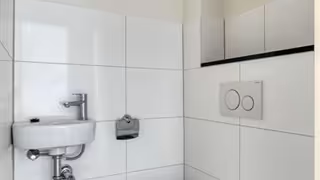


€1,470 / month


€3,250 / month


€2,650 / month
Dubbeldam: The Village within the City
Dubbeldam was an independent municipality until 1970 and still behaves like one. Wide avenues, lots of greenery, generous plots, its own schools and sports clubs, a weekly market on Tuesdays. It is Dordrecht's most sought-after family neighborhood — and you can tell by the availability: homes that become available here are quickly snapped up.
The housing stock predominantly consists of single-family homes: terraced houses, semi-detached houses, and corner houses with front and back gardens. The construction period varies from the 1970s to recent new builds. The village-like character is expressed not only in the architecture but also in the social fabric: Dubbeldam has an active community life, its own shopping center, and close ties between residents.
For families with school-aged children, the combination of space, amenities, and safety is the main draw. The downside: the supply of rental homes here is scarcer than in other neighborhoods, and prices are higher than the Dordrecht average.
Sterrenburg: Space on the Edge of the Biesbosch
With approximately 22,000 inhabitants, Sterrenburg is Dordrecht's largest district. Built from the 1960s to the early 1980s, it's divided into three parts, each with its own character. The first part has more gallery flats and walk-up apartments; the later parts are more spacious with more single-family homes and ground-level terraced houses.
What distinguishes Sterrenburg from similar post-war neighborhoods elsewhere is its location. The district directly borders the Dordtse Biesbosch — the nature and recreation area that forms the transition to the National Park. The Sterrenburgpark and the Oostkil form a continuous green zone that extends to the water. Dordrecht Zuid station is located within the district, and the N3 provides direct access to the A16.
The housing supply here is the most diverse in the city: from walk-up apartments and gallery flats to single-family homes with gardens and newer terraced houses. Sterrenburg is the neighborhood where families looking for the space of Dubbeldam but wanting more choice in type and price range will find their home.
Stadspolders: The Newest District, the Most Tranquility
Stadspolders was built in the 1980s and 1990s on the east side of the city, later expanded with the Vissershoek and Oudelandshoek neighborhoods. The name says it all: this is a polder that became a city, and you can see that in its layout. Wide streets, clear subdivisions, many single-family homes with gardens, and on the edges, the transition to open polder landscape, the Wantij, and the Bilderbos.
Dordrecht Stadspolders station gives the district its own train connection — convenient for commuters heading towards Rotterdam or Breda. The neighborhood has its own schools, sports facilities, and shops. It's the place in Dordrecht where urban and rural life are closest: in the morning, taking the train to work in Rotterdam, in the evening, cycling to the Wantij.
Houses Price Breakdown in Dordrecht
| Size | Average | Median | Price Range | Available |
|---|---|---|---|---|
€1,699 | €1,610 | €1,425 - €2,150 | 4 | |
€2,650 | €2,650 | €2,650 - €2,650 | 1 | |
€3,250 | €3,250 | €3,250 - €3,250 | 1 | |
€2,950 | €2,950 | €2,950 - €2,950 | 1 |
Krispijn: Pre-war Character, Urban Location
Between the city center and Wielwijk lie Oud-Krispijn and Nieuw-Krispijn, separated by the ponds along the Nassauweg. Oud-Krispijn has a stock of pre-war homes that is unparalleled in Dordrecht — 1930s architecture, small front gardens, a human scale not found in post-war neighborhoods.
Nieuw-Krispijn is largely from the 1950s but has acquired a more mixed character in several places due to urban renewal. The Weizigtpark with the Sustainability Center is centrally located in the neighborhood. The station and the city center are within cycling distance.
Krispijn is the neighborhood for those who want to combine the atmosphere of a pre-war street with an urban location — not the polder tranquility of Stadspolders, not the monumental grandeur of the city center, but something in between: a recognizable neighborhood with its own local shops and a scale suitable for families and couples.
Crabbehof, Wielwijk, and Zuidhoven: Affordable and Evolving
The neighborhoods on the southwest side of the city were built in the 1950s and 1960s. Crabbehof takes its name from the small castle that still stands in the district. The layout is characteristic: square green spaces referring to medieval courtyards, streets named after statesmen, and a district shopping center with some forty shops. Wielwijk, built at record speed around 1957 with almost 3,000 homes, has Admiraalsplein as its center. Zuidhoven differs with more detached houses and larger plots.
These neighborhoods have lower resident satisfaction than Dubbeldam or Sterrenburg, and the social challenges are greater. But there's also another story: the restructuring that has been ongoing for years is yielding new-build homes that compete in quality with the rest of the city. Those willing to look beyond the statistics will find the widest range and lowest rental prices in Dordrecht here — and a neighborhood in motion.
Three Stations, One Waterbus
Dordrecht Centraal, Dordrecht Zuid, and Dordrecht Stadspolders give the city three entry points to the rail network. The Waterbus sails from Merwekade and Hooikade to Rotterdam, Zwijndrecht, Papendrecht, and the Biesbosch. The A16 and N3 provide car access. Cycling is dominant for daily traffic — distances are limited and routes are flat.
The Drechtsteden as a Search Area
Dordrecht is the center of the Drechtsteden: Zwijndrecht, Papendrecht, Sliedrecht, Hendrik-Ido-Ambacht, Alblasserdam, and Hardinxveld-Giessendam. The municipalities share a labor market and are connected by the Waterbus. Those who broaden their search area to the surrounding towns will find comparable homes, often at lower rental prices, with the same connections.
Biesbosch on Your Doorstep
National Park de Biesbosch — 9,000 hectares of freshwater tidal area — begins where Dordrecht ends. Accessible by bike, canoe, or Waterbus. The Biesbosch MuseumEiland on the Dordrecht side is the starting point. This is why many families choose Dordrecht over comparable cities: this combination of city and nature is unique in South Holland.
Responding to a Property in Dordrecht
Free-sector housing availability in Dordrecht is limited, and popular properties attract multiple candidates. Speed matters: ensure your proof of income, employer's statement, and identification are immediately available. On our platform, you can set up an alert to receive immediate notifications when a new property matching your criteria comes online.
For properties with a garden, it's wise to inquire about garden maintenance responsibility during the viewing — for some landlords, this is an explicit part of the rental agreement. Also, ask about the energy label: in a city where much of the housing stock dates from the 1960s and 1970s, the difference in heating costs between a renovated and a non-renovated property can be significant.
View Current Listings
Filter by neighborhood, price, and property type.
View Rental Homes in Dordrecht